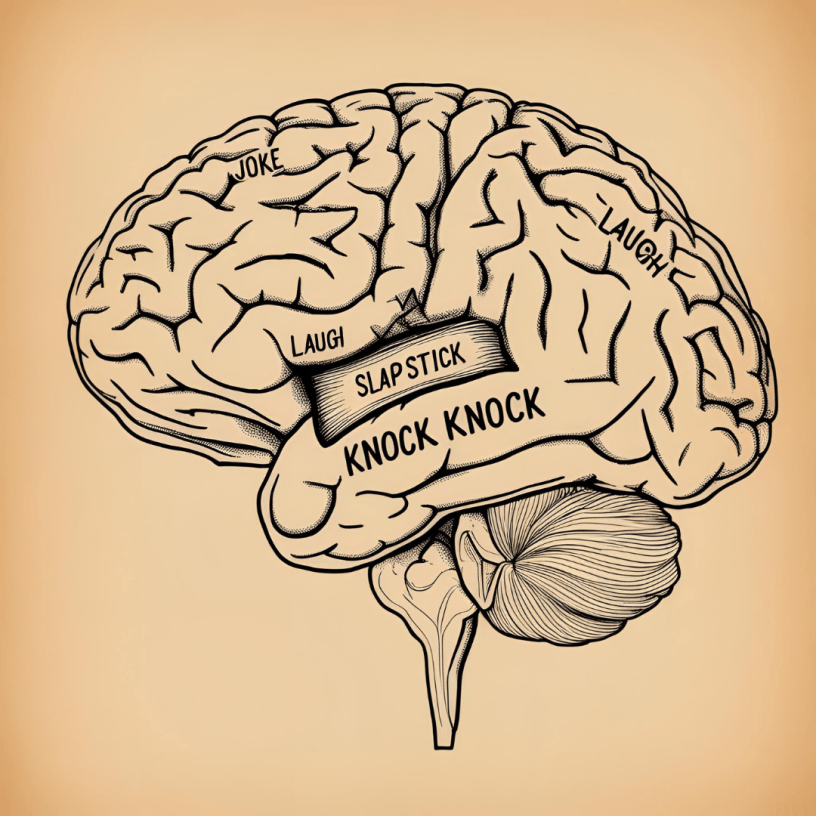
We (humans) are a strange bunch. We spend significant chunks of our fleeting existence glued to screens, watching other humans intentionally make fools of themselves. And what do we do in response? We emit a series of involuntary (mostly) guttural noises – laughter. It’s a bizarre behavior when you really think about it. But beneath the ha-has and the snorts lies a complex symphony of brain activity that’s important for our social fabric.
The Anatomy of a Giggle: More Than Just a Belly Rub
Let’s be clear: laughter isn’t just a reflex. It’s a social signal with roots deep in our primate past. Think about it – you’re far more likely to erupt in laughter when you’re surrounded by others than when you’re staring blankly at a wall. This isn’t just about shared experience; it’s about connection, about signaling agreement, affection, even emotional regulation within a group.
Neurologically, the act of laughing is far from monolithic. Researchers have peered inside our skulls using fMRI scans and discovered that different types of laughter activate distinct brain regions. That hearty, joyous belly laugh you share with friends? That’s neurologically different from the sharp, sometimes cruel, “schadenfreude” laughter at someone else’s misfortune. Even the simple act of being tickled triggers a different kind of non-emotional laughter compared to laughter that carries social information. The pitch variations between joyous and taunting laughter alone show distinct neurological underpinnings.
This distinction between laughing at someone and laughing with someone is crucial. The former can be rooted in a sense of superiority, a concept philosophers like Plato touched upon centuries ago. But the latter? That’s the social glue, the neurobiological high-five that strengthens bonds. Studies on chimpanzees, our close evolutionary cousins, reveal similar patterns: laughter during play serves to prolong the interaction, further highlighting its social function.
The Comedy Code: Cracking the Brain’s Expectation Engine
Now, what about the stuff that triggers this laughter in the first place? Comedy, in its various forms, is essentially about playing with our expectations, about creating incongruity. Our brains are prediction machines, constantly building “scripts” or “frames” about how the world works based on past experiences. Imagine expecting a waiter to take your order at a restaurant – that’s a script in action.
Comedy thrives by subverting these scripts. Think of a classic one-liner: the setup leads you down one path, and the punchline yanks you in an unexpected, often illogical, direction. It’s in this violation of expectation that the humor often lies. And it’s the brain’s frontal lobes, the executive control center, that are key to making sense of this discrepancy. They’re the ones rapidly shifting between the initial assumption and the alternative, humorous interpretation. This ability to juggle multiple mental interpretations is something very human, thanks to our relatively massive frontal lobes and our highly evolved working memory.
Neuroscientists often talk about the “incongruity resolution” model of humor. First, your expectations are upended. Then, your brain kicks into problem-solving mode, trying to reconcile the unexpected twist. When you “get” the joke, when the pieces click into place, there’s a moment of insight, and that’s where the mirth often sparks. Fail to resolve the incongruity? Cue the awkward silence, the comedic equivalent of a failed product launch.
The Reward of the Punchline: Hooking Our Pleasure Centers
But humor isn’t just about cognitive processing; it’s also deeply tied to emotion and reward. When a joke lands, it’s not just an intellectual “aha!” moment; it feels good. And that’s because humor often activates the brain’s reward circuitry, the same network that lights up when we experience other pleasurable things like good food or social connection.
Studies using fMRI have shown that funny cartoons, compared to their humorless counterparts, elicit greater activity in areas like the nucleus accumbens, a key player in the mesolimbic reward system. This suggests that humor has an intrinsic rewarding value, which might explain why we actively seek it out in movies, TV shows, and …blogs …hmm.
Interestingly, research using more dynamic, socially rich forms of humor, like stand-up comedy, also points to this reward system activation. Watching a comedian weave jokes, using verbal cues and nonverbal expressions, engages these pleasure centers, reinforcing the idea that social humor is inherently rewarding. This reward mechanism might even explain why we tend to like people who make us laugh; we associate that good feeling with them.
The Novelty Factor: Why Yesterday’s Jokes Aren’t Always Funny
Ever notice how a joke that had you roaring with laughter the first time elicits little more than a polite chuckle on the second go-around? Studies have shown that when we watch comedy for the first time, several brain regions, including areas in the prefrontal cortex, temporal lobe, and even the reward-related striatum and amygdala, show heightened activity. This flurry of activity is likely linked to the initial process of detecting the incongruity, resolving it, and experiencing the associated reward.
However, upon re-viewing, the brain’s response often diminishes in these same areas. The surprise is gone, the script subversion is predictable, and the reward signal weakens. This reduction in brain activity reflects the decreased novelty of the comedic events. It’s like a product feature that wows in version 1.0 but becomes table stakes in the next iteration. The brain, ever efficient, doesn’t need to work as hard to process something it’s already encountered.
The Frontal Pole: A New Frontier in Funny Business
Intriguingly, research using longer comedy movie clips has highlighted the role of the frontal pole, the most anterior part of the prefrontal cortex, in processing humor. This area, known for its involvement in higher-order cognitive functions like planning and integrating information over longer time scales, seems to be particularly active when we experience humorousness. The idea is that humor in longer formats might unfold over several seconds, requiring the frontal pole’s ability to hold information and reinterpret it in light of new developments. This is a relatively novel finding and suggests that our appreciation of complex, narrative-driven comedy might engage even more sophisticated brain mechanisms… hence, the success of comedians such as Norm MacDonald (RIP).
So What?
When you find yourself chuckling at a stand-up comedian’s observational wit or guffawing at a slapstick moment in a movie, there’s a whole lot more going on beneath the surface than just a momentary release of tension. Your brain is actively decoding, resolving, and rewarding you for engaging with the absurdity of the human condition. And in a world that often feels relentlessly serious, that shared moment of laughter might just be one of the most profoundly human things we can do.
Bibliography
Ayan, S. (2009). Laughing matters. Scientific American Mind, 20(2), 24-31. https://www.jstor.org/stable/24940104
Franklin, R. G., & Adams, R. B. (2011). The reward of a good joke: neural correlates of viewing dynamic displays of stand-up comedy. Cognitive, Affective, & Behavioral Neuroscience, 11, 508-515. https://doi.org/10.3758/s13415-011-0049-7
Jääskeläinen, I. P., Pajula, J., Tohka, J., Lee, H. J., Kuo, W. J., & Lin, F. H. (2016). Brain hemodynamic activity during viewing and re-viewing of comedy movies explained by experienced humor. Scientific reports, 6(1), 27741. https://doi.org/10.1038/srep27741
James, C. (2018). The neurological research on laughter: Social context, joys, and taunts. Israeli Journal for Humor Research, 7(1), 8-16 https://hdl.handle.net/10428/5861
Restak, R. (2013). Laughter and the Brain. The American Scholar, 82(3), 18-27.
Scott, S. K., Lavan, N., Chen, S., & McGettigan, C. (2014). The social life of laughter. Trends in cognitive sciences, 18(12), 618-620. https://doi.org/10.1016/j.tics.2014.09.002
Discover more from Prefrontal
Subscribe to get the latest posts sent to your email.
 Prefrontal