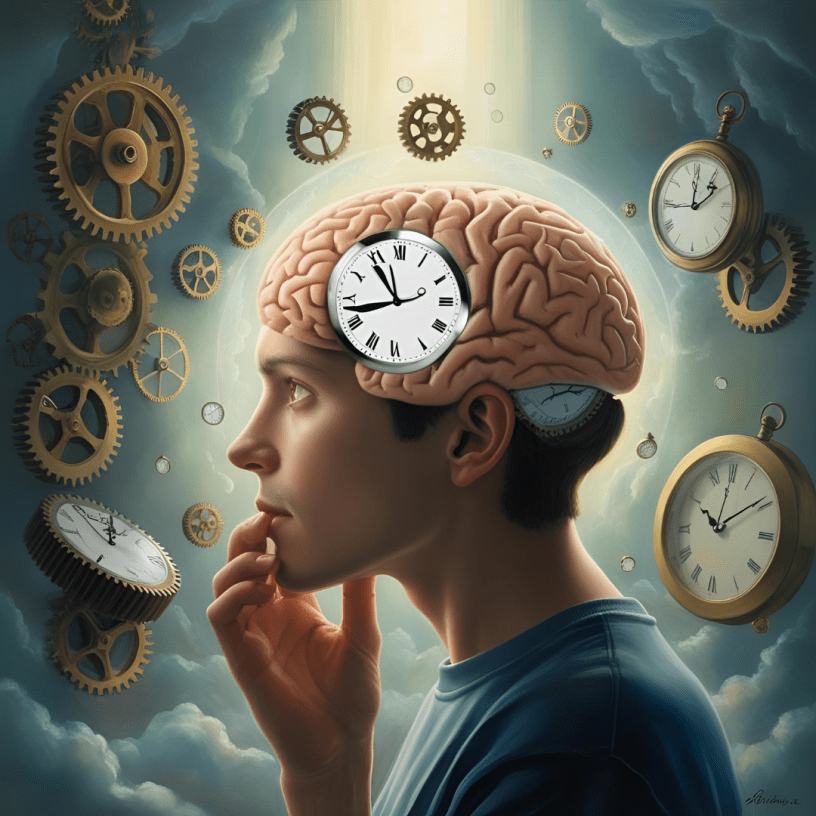
Time. It’s this weird thing that marches on, whether you’re crushing it at work or just crushing another bag of Doritos on the couch. You’d think something so fundamental to the human experience – knowing how long a meeting is dragging or whether you’re about to miss your flight – would be pretty well figured out. But surprise, surprise, it’s a hot mess of competing ideas. Let’s break down some of the different models researchers use when trying to understand how our brains handle this slippery concept.
The Ticking Clock in Your Head (Maybe)
For ages, one of the dominant theories has been the idea of an internal clock. Think of it like a mental metronome, supposedly ticking away in your skull. The theory goes that this “pacemaker” spits out regular pulses, kind of like the ticks of a clock. These ticks then get collected in some sort of mental “accumulator”. The more ticks that pile up, the longer you perceive an event to be.
Now, there are variations on this theme. One idea is that this mental gatekeeper, attention, decides which of these time-ticks actually get counted. If you’re engrossed in something, your attention might be diverted, and fewer ticks get registered, making that fun activity seem to fly by. Conversely, if you’re staring at the clock waiting for your Uber, every millisecond feels like an eternity because your attention is laser-focused on the passage of time. This suggests that our perception of how long something lasts isn’t just about some objective internal clock, but also about what we’re paying attention to.
…But not everyone buys this clock theory.
Time as a Byproduct of Brain Activity
Your brain is constantly buzzing with activity, neurons firing, networks evolving. One alternative theory, called the “state-dependent networks” model, suggests that the very way these brain networks change over time can actually code for time itself. It’s like the brain leaves a trace of what happened a few hundred milliseconds ago in its network state. So, instead of a dedicated clock, time is encoded in the pattern of neural activity.
This idea gets interesting when you consider short versus long intervals. The research suggests that for really short durations (like a blink of an eye), our brains might treat time like a “temporal object,” something encoded in the complex, ever-shifting state of brain networks. But for longer durations (think minutes), we might switch to something more akin to that internal clock we talked about earlier. This implies that our brains might have different ways of dealing with time depending on the timescale.
Interestingly, this state-dependent network idea suggests that time processing isn’t some centralized operation in one specific brain region. Instead, it’s distributed throughout the brain. This would make the search for a single “time center” in the brain a bit of a wild goose chase.
Your Feelings Mess With the Clock (or Whatever It Is)
Now, let’s throw another wrench in the works… emotions. Remember how time flies when you’re having fun? That’s not just a saying. Studies show that our emotional state can significantly warp our perception of time.
Think about being scared. Some people report that time seems to slow down in terrifying situations. On the flip side, when you’re really engaged and happy, time can feel like it’s speeding up. Researchers have even called this the “time-emotion paradox“.
The link between emotions and time perception might be deeply rooted in our bodily sensations. There’s a growing idea that our subjective sense of time is strongly “embodied”. This means our perception of duration might be tied to the signals our brain receives from our bodies – our heart rate, our breathing, the feeling in our gut.
One key brain area implicated in this is the insular cortex. This region is like the brain’s hub for processing information about our internal bodily states and emotions. Some researchers propose that the insula might be constantly integrating these body signals, and this accumulation of “feeling states” could be the basis for our sense of how much time has passed. It’s like your body’s internal rhythm contributes to your subjective experience of time.
Different Clocks for Different Chimes?
It’s also highly likely that our brains don’t rely on just one timekeeping mechanism for all durations. We probably have different neural processes for perceiving milliseconds versus seconds versus minutes. For example, very short intervals might be processed more automatically in motor-related areas, while longer intervals might involve more cognitive control from the prefrontal and parietal cortices. Think of it like having different tools in a toolbox for measuring different lengths of time.
The Spatial-Temporal Tango (or Not)
Here’s another interesting twist: the way we talk and think about time often uses spatial metaphors. We say things like “the future is ahead of us” or “the past is behind us”. This has led some to believe that our understanding of time might be grounded in our understanding of space. The idea is that we use our well-developed spatial reasoning abilities to make sense of the more abstract concept of time.
However, not everyone agrees that this linguistic link means time concepts are fundamentally “embodied” in the same way as, say, the concept of “grasping” something might be linked to motor areas. Some researchers argue that we develop “purely” temporal concepts (like “now” or “later”) even before we start using spatial metaphors for time. So, while we might use space to talk about time, it doesn’t necessarily mean our perception of time is solely based on spatial representations in the brain.
The Bottom Line: We’re Still Figuring It Out
So, it’s clear that the perception of time is not a simple, straightforward process. There’s no single “time organ” ticking away in our brains. Instead, it seems to be a complex interplay of different cognitive processes, distributed neural networks, and our ever-shifting emotional and bodily states. While the classic internal clock model provided a useful starting point, newer research highlights the importance of dynamic brain activity and the close link between our bodies and our sense of time. The influence of attention, memory, and our emotional landscape further complicates the picture.
The truth is, despite significant advances in cognitive neuroscience, the precise mechanisms by which our brains create this fundamental experience of time remain largely unknown. It’s a puzzle that continues to intrigue and challenge researchers across disciplines. Ultimately, our subjective experience of time is a fascinating reminder of the brain’s incredible complexity. It’s a testament to how our minds weave together a multitude of signals and processes to create our conscious reality – even something as seemingly basic as knowing how long we’ve been stuck in this never-ending meeting. Now, if you’ll excuse me, it feels like it’s been an eternity, and I need a coffee.
Bibliography
Eagleman, D. M., Peter, U. T., Buonomano, D., Janssen, P., Nobre, A. C., & Holcombe, A. O. (2005). Time and the brain: how subjective time relates to neural time. Journal of Neuroscience, 25(45), 10369-10371. https://doi.org/10.1523/JNEUROSCI.3487-05.2005
Kranjec, A., & Chatterjee, A. (2010). Are temporal concepts embodied? A challenge for cognitive neuroscience. Frontiers in Psychology, 1, 240. https://doi.org/10.3389/fpsyg.2010.00240
Kusnir, F., & Landau, A. N. (2025). Temporality and the Brain: The Long and Winding Emergence of Time in Cognitive Neuroscience. Human Arenas, 1-23. https://doi.org/10.1007/s42087-025-00497-8
van Wassenhove, V. (2023). Cognitive neuroscience of time: nows, timelines, and chronologies. In Time and science: Volume 2: Life sciences (pp. 97-129). https://doi.org/10.1142/q0405-vol2
Wittmann, M. (2009). The inner experience of time. Philosophical Transactions of the Royal Society B: Biological Sciences, 364(1525), 1955-1967. https://doi.org/10.1098/rstb.2009.0003
Wittmann, M. (2013). The inner sense of time: how the brain creates a representation of duration. Nature Reviews Neuroscience, 14(3), 217-223. https://doi.org/10.1038/nrn3452
Discover more from Prefrontal
Subscribe to get the latest posts sent to your email.
 Prefrontal