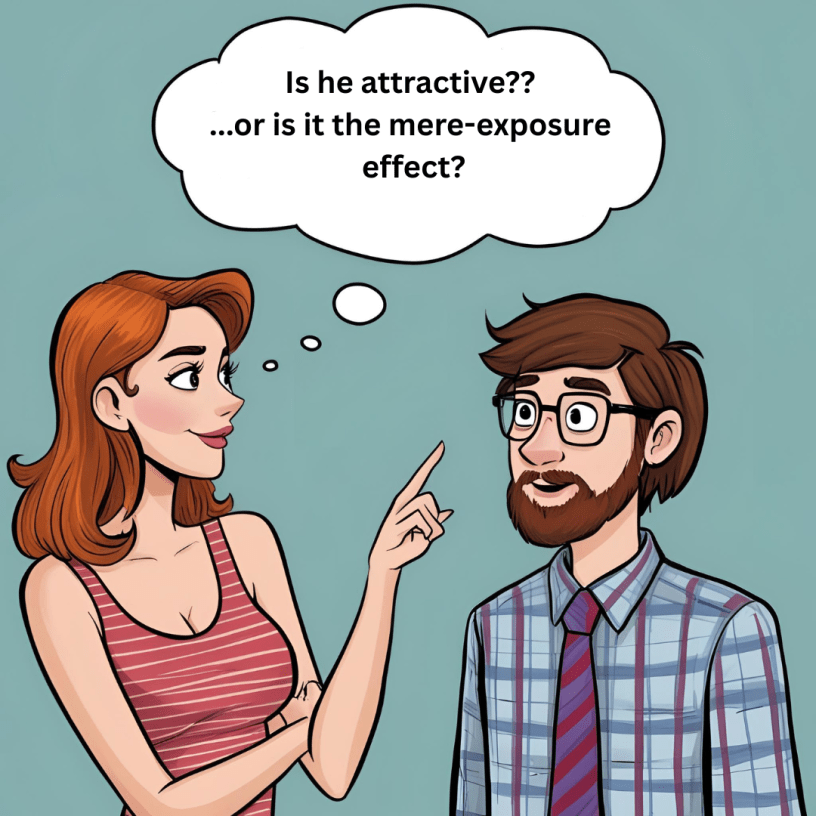
We live in a world obsessed with novelty, with the next shiny object promising to disrupt and delight. But beneath the surface of our craving for the new lies a different primal force: familiarity. It’s the quiet hand on the tiller of our preferences, subtly guiding our likes and dislikes often without our conscious awareness. This is the profound impact that repeated exposure has on preference. Have you ever wondered why some people tend to “grow on us” over the years? It is all about the mere-exposure effect.
What Exactly Is the Mere-Exposure Effect?
The mere-exposure effect is a psychological phenomenon where people tend to develop a liking for things merely because they are familiar with them. Think of it as the psychological equivalent of a slow burn. Initially, encountering something new can trigger a degree of caution, a natural hesitance towards the unknown. But with each subsequent interaction, this initial apprehension fades, replaced by a growing sense of comfort and, often, a positive inclination. In the realm of social dynamics, this is sometimes referred to as the familiarity principle: the more we encounter someone, the more pleasing and likeable we tend to find them. This effect isn’t limited to people; it extends to a surprisingly broad range of stimuli, from the abstract to the concrete, encompassing words, Chinese characters, paintings, pictures of faces, geometric figures, foods, and even sounds.
The scholar most closely associated with unearthing and developing our understanding of this effect is Robert Zajonc. His early observations noted that organisms initially respond to novel stimuli with fear or avoidance. However, repeated exposure leads to a reduction in this fear response and an increase in interest. This insight paved the way for extensive research demonstrating that repeated exposure of an individual to a stimulus is a sufficient condition for the enhancement of their attitude toward it. Zajonc’s experiments involved presenting stimuli at suboptimal thresholds, so brief that participants weren’t consciously aware of seeing them, yet they still exhibited a preference for the repeatedly shown stimuli. This led to his assertion that “preferences need no inferences”, challenging the notion that our likes and dislikes are always rooted in rational evaluation.
Seen It, Liked It? Examples in the Wild
The mere-exposure effect is a pervasive force molding our everyday experiences. Consider language: a word we initially find strange or complex can become commonplace and even agreeable simply through repeated hearing and use. The same principle applies to art: a modern painting that initially strikes us as jarring or incomprehensible might grow on us with repeated viewings, eventually eliciting a sense of appreciation. Our attraction to faces is also heavily influenced by this effect; studies have shown that the more often we see someone’s face, the more pleasing and likeable we find them.
A particularly illustrative example comes from a real-world experiment conducted at Oregon State University. A professor had a student attend his class for an extended period concealed in a large black bag with only his feet visible. Initially, the other students reacted with hostility towards this bizarre presence. However, over time, as the black bag became a familiar fixture in the classroom, the students’ attitudes shifted from hostility to curiosity and eventually even to friendship. This absurd scenario (super bonkers!) demonstrates how mere repeated presentation can transform our feelings towards something initially strange or off-putting.
Ad of course, marketers and consumer behavior practitioners cannot ignore the mere-exposure effect…. It appears to be a cornerstone of many advertising strategies. Companies bombard us with repeated exposure to their logos, brand names, and products, the underlying assumption being that familiarity will breed positive feelings and ultimately drive purchasing decisions. The mere-exposure effect even touches the finance sector. Many stock traders exhibit a tendency to invest in securities of domestic companies, not necessarily due to superior performance, but simply because they are more familiar with them. Similarly, in academia, researchers tend to rate journals they have previously published in (or reviewed for) as being of higher quality, again highlighting the influence of familiarity on perceived value.
For the Suits: Marketing Implications
For marketers, the mere-exposure effect is a double-edged sword, a tool that needs to be wielded with precision. The most obvious application lies in advertising, where repeated exposure to brand messaging can indeed enhance consumer attitudes towards companies and products. The principle suggests that consumers don’t necessarily need to deeply engage with or think critically about advertisements; simple repetition can be enough to create a “memory trace” in the consumer’s mind and unconsciously influence their purchasing behavior. Yet, the relationship isn’t always linear. A meta-analysis of over 200 experiments found that while the mere-exposure effect is robust, it reaches its maximum effect within 10–20 presentations, and beyond that, “liking” can actually decline. Think of that song you initially loved but now skip every time it comes on – that’s the mere-exposure effect in reverse, sometimes referred to as stimulus satiation. Furthermore, research has shown that higher levels of media exposure can sometimes be associated with lower reputations for companies, even if the exposure is largely positive. This suggests that excessive or intrusive exposure can lead to ambivalence as consumers develop a multitude of associations, both favorable and unfavorable.
The effect is most potent when a company or product is new and unfamiliar to consumers. For established brands, simply increasing exposure might not yield the same positive results. Moreover, exposure to something we initially dislike can actually make us dislike it even more. Therefore, marketers need to be cautious about blindly increasing exposure without considering the initial perception of their brand or product. Interestingly, a delay between exposure and the measurement of liking tends to increase the strength of the effect. This suggests that the subconscious impact of familiarity can solidify over time.
Buyer Beware: Implications for Consumers
As consumers, understanding the mere-exposure effect can help us become more aware of the subtle influences shaping our choices. We might find ourselves gravitating towards brands or products we’ve seen repeatedly, even if there’s no objective reason to believe they are superior. This can lead us to make decisions based on liking, driven by familiarity, rather than on substantial thought or evaluation of alternatives. The earlier references tendency for stock traders to favor familiar domestic companies, even when international markets offer better opportunities, is a stark reminder of how this bias can influence significant financial decisions.
It’s also important to be aware of the connection between mere exposure and the illusory truth effect. This effect suggests that repeating a false statement can increase its believability simply due to familiarity (ever wonder why some politicians continue to make blatantly false statements over and over again?…. hmm). The illusory truth effect highlights the broader implications of how repeated information, regardless of its veracity, can influence our perceptions and beliefs.
Navigating Life: Implications for Individuals
Beyond the realm of consumerism, the mere-exposure effect shapes our social interactions and personal preferences in important ways. In interpersonal attraction, the more often we see someone, the more pleasing and likeable we tend to find them. This seemingly simple principle underpins the propinquity effect, which highlights the role of physical or psychological proximity in the formation of friendships and romantic relationships. Our daily interactions with colleagues, neighbors, and classmates can foster positive feelings simply through repeated exposure (unless you are my old high school math teacher).
However, the effect isn’t universally positive in social contexts. When groups already harbor negative attitudes towards each other, further exposure can unfortunately increase hostility. Familiarity, in this context, can reinforce existing biases rather than promote understanding. This underscores the importance of positive initial interactions and shared positive experiences in fostering good intergroup relations. On a more individual level, the mere-exposure effect can influence our aesthetic preferences, our comfort levels with different environments, and even our political leanings, as familiarity with a candidate can significantly impact voting patterns, distinct from the popularity of their policies.
Raising Humans: Implications for Parents
For parents, understanding the mere-exposure effect offers some insights into shaping children’s preferences and behaviors. Introducing new foods, for example, might be more successful with repeated, non-coercive offerings, allowing the child to become more familiar with the taste and texture, potentially leading to increased acceptance over time. Similarly, repeated exposure to different types of music, art, or activities can broaden a child’s horizons and foster new interests.
The Nuances and the Caveats
While the core principle of the mere-exposure effect is relatively straightforward, its manifestation is influenced by a variety of factors. The type of stimulus matters; for instance, the effect might be stronger for unfamiliar stimuli presented briefly compared to more complex stimuli. There’s also the frequency of exposure, as the relationship between exposure and liking often follows an inverted-U shaped curve, where liking increases up to a certain point and then begins to decline with overexposure, leading to boredom or satiation. The delay between exposure and evaluation also plays a role, with longer delays often increasing the strength of the effect.
Conclusion: The Power of Showing Up (Repeatedly)
The mere-exposure effect tells us that familiarity breeds liking. This isn’t always a conscious or rational process; often, it operates beneath the surface, subtly shaping our preferences and attitudes through the simple act of repeated experience. From the development of our tastes to the formation of our relationships and even our consumer choices, the power of “showing up” again and again has an impact. Whether you’re a marketer seeking to build brand affinity, a consumer aiming to understand your own biases, an individual navigating social landscapes, or a parent guiding a child’s development, understanding the mere-exposure effect offers some useful insights. … and I recommend reading posts on this blog several times over the next week, so that it can grow on you.
Bibliography
Hansen, J., & Wänke, M. (2009). Liking what’s familiar: The importance of unconscious familiarity in the mere-exposure effect. Social cognition, 27(2), 161-182. https://doi.org/10.1521/soco.2009.27.2.161
Harmon-Jones, E., & Allen, J. J. (2001). The role of affect in the mere exposure effect: Evidence from psychophysiological and individual differences approaches. Personality and Social Psychology Bulletin, 27(7), 889-898. https://doi.org/10.1177/0146167201277011
Montoya, R. M., Horton, R. S., Vevea, J. L., Citkowicz, M., & Lauber, E. A. (2017). A re-examination of the mere exposure effect: The influence of repeated exposure on recognition, familiarity, and liking. Psychological Bulletin, 143(5), 459. https://psycnet.apa.org/doi/10.1037/bul0000085
Rhodes, G., Halberstadt, J., & Brajkovich, G. (2001). Generalization of mere exposure effects to averaged composite faces. Social Cognition, 19(1), 57-70. https://doi.org/10.1521/soco.19.1.57.18961
Zajonc, R. B. (2001). Mere exposure: A gateway to the subliminal. Current Directions in Psychological Science, 10(6), 224-228. https://doi.org/10.1111/1467-8721.00154
Discover more from Prefrontal
Subscribe to get the latest posts sent to your email.
 Prefrontal