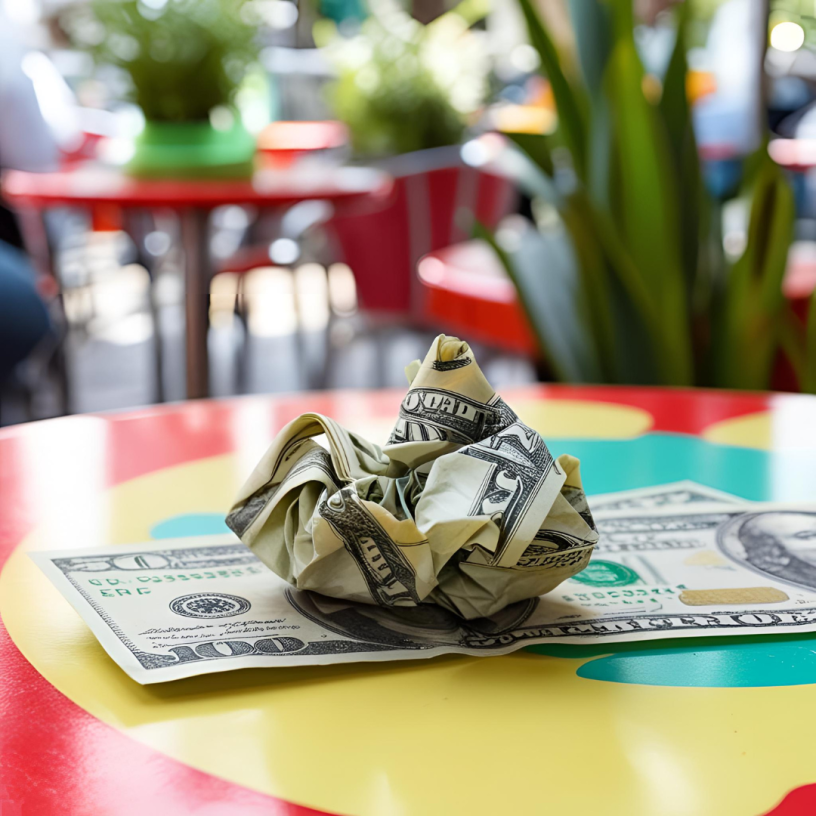
Let’s talk about tipping. That unique ritual, the silent negotiation that happens after the last bite as the bill arrives. It’s a cultural artifact, an economic oddity, and a constant source of anxiety for both giver and receiver. Tipping is a real-world transaction with tangible consequences, steeped in a history as peculiar as the motivations behind it.
From Aristocratic Indulgence to American Expectation
The quaint notion of leaving a little extra for good service didn’t exactly spring from the egalitarian ideals we supposedly hold dear. In fact, its origins smack of the very European aristocracy our forefathers sought to escape. As Segrave notes, tipping likely began centuries ago as a way for the landed gentry to show appreciation or even compassion to their servants. But fast forward to the shores of the New World, and in the early days of the Republic, tipping was viewed with suspicion, an affront to the burgeoning democratic spirit where a fair wage for honest work was the supposed standard.
Yet, by the late 19th and early 20th centuries, this European import had taken root, particularly in the burgeoning hospitality industry. Why the reversal? Blame the transition from the “American Plan,” where meals were included in the hotel room rate, to the “European Plan,” where they were sold separately. Suddenly, dining establishments saw an opportunity. Tips could supplement wages, easing the burden on the owners’ payrolls.
The debate raged. Prominent figures like Rockefeller and Emerson decried tipping as un-American. Anti-tipping laws even popped up, though they proved about as effective as a screen door on a submarine. By the 1920s, opposition had largely faded, and tipping had become thoroughly entrenched. Prohibition, ironically, might have even hastened its solidification as hotels converted bars to “lunch rooms” where tipping was more readily accepted for a la carte service. What was once seen as aristocratic fawning was now, according to some, a mark of American patriotism. Go figure.
The Economics of Generosity (or Lack Thereof): Why We Tip (and Why We Sometimes Don’t)
So, we’re stuck with it. But why do we actually fork over that extra 15, 20, or increasingly, 25 percent? The motivations are as varied as the customers walking through the door. At its core, a tip is a voluntary payment for service already rendered. From a purely rational economic standpoint, once the food is eaten and the drink is drunk, there’s no inherent need to pay more. Yet, the tipping economy in the US food industry alone is estimated to be a staggering $47 billion annually. Clearly, something beyond pure self-interest is at play.
One major driver is social norms. We tip because it’s what’s expected. There are unspoken rules, percentages that hover in our minds, fueled by societal pressure and the fear of being perceived as cheap or inconsiderate. These norms are so powerful that service employees in the US often view a non-tipping customer as committing an offense equivalent to skipping out on the entire bill.
Then there’s the desire to reward good service. The traditional justification for tipping is that it incentivizes better performance. While the direct link between a specific tip and future service for a one-time customer is tenuous, the cumulative effect within the industry might play a role. However, research suggests that the correlation between service evaluations and tip size might be weaker than we think, indicating other factors are at play.
Impression management is another significant motivator. We might tip more generously when we’re with company we want to impress. The size of the tip can be a signal, a way to project an image of generosity and social standing. This explains why tipping might be higher in social situations and potentially even influenced by payment methods, with credit card payments sometimes leading to larger tips. A customer may even attempt to manage the impression they leave a server with (ever wonder why more attractive servers tend to take home more tips?).
Altruism and empathy also play a role, particularly when economic hardship is perceived. The desire to help servers, especially those working for subminimum wages, can drive up tip percentages, particularly during times of economic downturn. This was evident during the COVID-19 pandemic, where despite restaurant closures, tipping behavior often increased, perhaps driven by a sense that service staff needed and deserved more support.
Finally, the context of the interaction itself matters. Server attributes and behaviors, such as attentiveness, the use of touch (though this is a delicate area), and even squatting down next to a table, have been shown to influence tipping behavior. Even seemingly minor cues, like personalized greetings, can have an effect.
The rise of digital payment systems has introduced a new layer of complexity. Those pre-calculated tip options on tablet screens – often starting at seemingly inflated percentages – can act as what behavioral economists call nudges, influencing our decisions through suggested defaults. While intended to make tipping easier, they can also induce “tip creep” and make the “no tip” button feel like a scarlet letter. Research suggests that the way these options are framed (absolute dollar amounts versus percentages) can impact the final tip, particularly for lower bill amounts.
The Subminimum Wage Saga: Tipping as a Band-Aid on a Systemic Problem
The elephant in the room when discussing tipping in the US is the subminimum wage for tipped employees. As of early 2024, the federal minimum wage for tipped workers remains a paltry $2.13 per hour, a figure unchanged since 1938. Employers in most states can use “tip credits” to meet the federal minimum wage of $7.25 per hour, meaning that tips are expected to make up the difference.
This system has deep historical roots. It essentially shifts the responsibility of providing a living wage from the employer to the customer. The consequences are stark: waitstaff and bartenders in states with the $2.13 subminimum wage face a significantly higher poverty rate compared to non-tipped workers. Conversely, states that mandate the full minimum wage for tipped employees see much lower poverty rates in these professions.
The argument that tips ensure better service becomes somewhat moot when the system is predicated on the idea that employers don’t have to pay a decent wage. It creates a precarious existence for millions of Americans who rely on the unpredictable nature of customer generosity to make ends meet. Moreover, this reliance on tips can lead to income instability and potential vulnerability to the whims of customers.
Interestingly, research indicates that restaurants in states without a tip credit and subsequently higher minimum wages for tipped employees do not necessarily perform worse financially; in fact, some studies suggest they may even have higher revenues. This challenges the notion that the subminimum wage is essential for the economic viability of the restaurant industry and hints at a potential pathway towards a fairer system. Yet, one thing that sticks out to me is that these studies do not report differences in restaurant incomes… which is what really matters in this discussion (i.e., income what is left over when costs are subtracted from revenues… and labor costs are at issue here).
The Modern Tipping Landscape: From 15% to the iPad Gauntlet
Today, the tipping landscape is in constant flux. What was once a relatively straightforward calculation of 15% is now a minefield of social pressures and digital prompts. The default tip percentages on those ubiquitous tablet payment systems seem to creep ever higher, nudging us towards 20%, 25%, or even more. The line between a genuine gratuity for exceptional service and a mandatory surcharge feels increasingly blurred.
The debate about the sustainability and fairness of the tipping model is intensifying. Some restaurants are experimenting with service charges or higher menu prices to provide more stable wages for their staff, aiming to move away from the reliance on customer tips. However, this shift can be met with resistance from both customers accustomed to the tipping ritual and servers who fear a decrease in their overall earnings.
The rise of tipping in contexts where it was previously uncommon – think coffee shops and takeout counters – further complicates the picture. Are we now expected to tip for every transaction involving a service worker, regardless of the level of interaction? The digital prompts make it almost unavoidable, leading to a sense of “tip fatigue” among consumers.
Key Takeaways: Navigating the Gratuity Minefield
So, what are the key takeaways from this peek into the world of US restaurant tipping?
First, tipping in America is not a purely organic expression of gratitude; it’s a deeply ingrained custom with a complex history.
Second, the motivations behind tipping are multifaceted, extending beyond just rewarding service. Social norms, impression management, and even empathy for low-wage workers all play significant roles. The rise of digital payment systems and default options has introduced new psychological factors influencing our tipping behavior (i.e., the tip nudge).
Third, the subminimum wage for tipped employees is a fundamental driver of the reliance on tipping in the US. This system shifts the burden of providing a living wage to customers and contributes to economic insecurity for service workers. My own reading of the academic research in this area leads me to the conclusion the jury is still out on whether abandoning the subminimum wage for tipped employees would harm the restaurant industry… this research needs to shift the key restaurant performance metric from sales revenue to income or some efficiency ratio that accounts for all costs to truly offer any informative value for the debate.
Fourth, the modern tipping landscape is evolving rapidly. Rising expectations, the proliferation of digital prompts, and the debate over alternative compensation models are creating a period of significant change and potential “tip fatigue” among consumers.
Ultimately, the Great American Gratuity reflects a unique and often contradictory set of values and economic realities. It’s a system that can reward excellent service but also perpetuate wage inequality. As consumers, we navigate this landscape guided by a mix of social pressure, personal ethics, and the ever-present nudge of the digital payment screen. Whether this deeply ingrained custom will endure in its current form remains to be seen, but understanding its history and the forces that shape it is crucial to engaging in a more informed and perhaps, a more equitable, dining experience.
Bibliography
Azar, O. H. (2004). The history of tipping—from sixteenth-century England to United States in the 1910s. The Journal of Socio-Economics, 33(6), 745-764. https://doi.org/10.1016/j.socec.2004.09.043
Bluvstein, S., & Raghubir, P. (2021). Absolutely Higher Tips; Framing Choice Alternatives in the New Age of Voluntary Payments Economy. Framing Choice Alternatives in the New Age of Voluntary Payments Economy (August 7, 2021). https://dx.doi.org/10.2139/ssrn.3919206
Bluvstein Netter, S., & Raghubir, P. (2021). Tip to show off: Impression management motivations increase consumers’ generosity. Journal of the Association for Consumer Research, 6(1), 120-129. https://www.journals.uchicago.edu/doi/abs/10.1086/710239
Dyussembayeva, S., Viglia, G., Nieto-Garcia, M., & Mattila, A. S. (2022). Would you like to add a gratuity? When explicit requests hamper tipping. Journal of Business Research, 139, 908-917. https://doi.org/10.1016/j.jbusres.2021.10.043
Isenberg, F. (2024). Factors Affecting Tipping Behavior: A Regression Analysis of State-Level Determinants (Honors Thesis, University of Oregon).
Mentzer, M. (2013). The payment of gratuities by customers in the United States: An historical analysis. International Journal of Management, 30(3), 108-120. https://harvest.usask.ca/server/api/core/bitstreams/271a6bdc-4781-4e78-835d-75ede1e6c6cb/content
Raghubir, P., & Bluvstein, S. (2024). From bribes to bequests and gifts to gratuities: The black, white, and shades of gray of how and why consumers pay what they want. Consumer Psychology Review, 7(1), 75-92. https://doi.org/10.1002/arcp.1099
Discover more from Prefrontal
Subscribe to get the latest posts sent to your email.
 Prefrontal