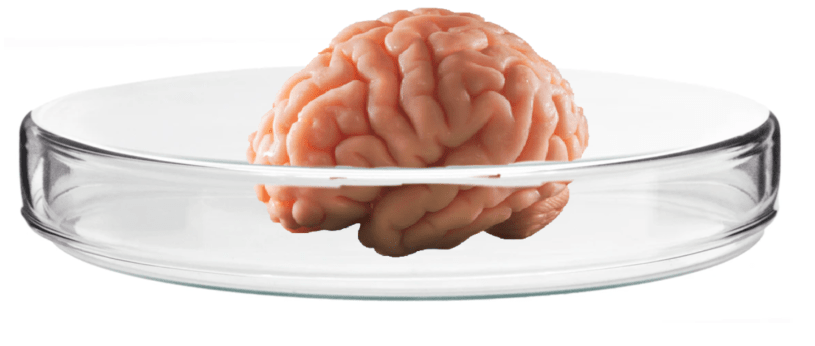
The Next Unicorn? Your Brain in a Petri Dish
Science has always been about hacking nature, but now we’re hacking ourselves—literally. Researchers have started growing tiny, brain-like structures called organoids, miniature models of the human brain that could unlock the mysteries of brain development and disease. If you think this is just another academic flex, think again. This is a biotech revolution with trillion-dollar potential.
For decades, scientists used mice to model human brain function. Spoiler: mice are not tiny humans. The fundamental differences between rodent and human neurodevelopment have been a bottleneck for understanding disorders like autism, schizophrenia, and microcephaly. Enter organoids—a game-changing innovation that brings brain research closer to, well, actual brains.
How to Grow a Brain (Sort of)
Madeline Lancaster and her team at the Institute of Molecular Biotechnology (Lancaster et al., 2013) cracked the code. Step one: stem cells—biological Swiss Army knives capable of morphing into any cell type. Step two: gel droplets that act as scaffolding for the cells to self-organize. Step three: a perpetual spinning system to simulate development. The result? A self-assembling, three-dimensional cluster of brain cells resembling a fetal brain in its early stages.
By two months, these organoids stop growing—not because of a lack of ambition, but because they don’t have a blood supply. They’re also missing key components of a real human brain, like immune cells and a vascular network. But here’s the kicker: the neurons within these lab-grown mini-brains fire in patterns eerily similar to actual human brain activity.
The Money Shot: Disease Modeling and the Bioeconomy
Scientists took their new toy for a spin by inserting a gene associated with microcephaly—a condition that causes underdeveloped brains. The organoids carrying the mutation were stunted, mimicking the disorder. This is where the magic happens: organoids let us study diseases in a way that’s impossible with traditional models. They provide a renewable, scalable way to investigate neurodevelopmental disorders in a controlled environment (Setia & Muotri, 2019).
Beyond disease modeling, organoids could become big business. Don’t be surprised if biobanks start popping up, storing and selling organoids derived from both healthy and diseased tissues (van de Wetering et al., 2015). This is great news for research accessibility, but not everyone’s thrilled. A for-profit organoid industry raises ethical questions about who owns human-derived tissues and whether it’s okay to commercialize human biology (Boers, van Delden, & Bredenoord, 2019).
The Downside: Limitations and Ethical Minefields
Not everything about organoids is perfect. Variability in how they develop makes standardization a challenge (Quadrato & Arlotta, 2017). And without a blood supply, they plateau early in development (Lancaster et al., 2013). But researchers are already testing ways to push the envelope—by vascularizing organoids or even grafting them into the brains of mice (Mansour et al., 2018). Yes, you read that right. Human brain tissue. Inside a living animal.
This leads to the big, unsettling question: at what point do these organoids become “somewhat sentient” (Lavazza & Massimini, 2018a)? And if they do, what are our ethical responsibilities? There’s already debate about whether it’s acceptable to keep developing increasingly complex organoids, especially if they start exhibiting signs of consciousness (Lavazza & Massimini, 2018b; Shepherd, 2018).
The Future: From Science Fiction to Medical Reality
The endgame here is obvious: organoids could eventually be used for therapeutic transplantation. Recent studies show that human cerebral organoids, when grafted into the brains of mice, integrate and even form bidirectional synaptic connections (Dong et al., 2020). This hints at the possibility of using organoids to repair damaged human brains. Sound crazy? So did heart transplants in 1967.
This research isn’t just a science experiment—it’s the foundation for a new biotech frontier. Organoids could disrupt neuroscience the way AI is disrupting tech. But as we get closer to hacking human biology at scale, we need to ask: who controls this technology? Who profits? And most importantly—are we ready for the ethical dilemmas that come with growing human brains in a dish?
Because in the end, the real question isn’t whether we can do it. It’s whether we should.
References (for the over achievers):
Boers, S.N., van Delden, J.J.M., & Bredenoord, A.L. (2019). Organoids as hybrids: ethical implications for the exchange of human tissues. Journal of Medical Ethics, 45(2), 144-145.
Cosset, E., Locatelli, M., Marteyn, A., Lescuyer, P., Antonia, F.D., Mor, F.M., Preynat-Seauve, O., Stoppini, L., & Tieng, V. (2019). Human neural organoids for studying brain cancer and neurodegenerative diseases. Journal of Visualized Experiments, 148, e59682.
Dong, X., Xu, S-.B., Chen, X., Tao, M., Tang, X-.Y., Fang, K-.H., Xu, M., Pan, Y., Chen, Y., He, S., & Liu, Y. (2020). Human cerebral organoids establish subcortical projections in the mouse brain after a transplantation. Molecular Psychiatry, DOI: 10.1038/s41380-020-00910-4.
Fatehullah, A., Tan, S.H., & Barker, N. (2016). Organoids as an in vitro model of human development and disease. Nature Cell Biology, 18, 246-254.
Lancaster, M.A., & Huch, M. (2019). Disease modelling in human organoids. Disease Models & Mechanisms, 12, dmm039347.
Lancaster, M.A., Renner, M., Martin, C-.A., Wenzel, D., Bicknell, L.S., Hurles, M.E., Homfrey, T., Penninger, J.M., Jackson, A.P., & Knoblich, J.A. (2013). Cerebral organoids model human brain development and microcephaly. Nature, 501(7467), 373-379.
Lavazza, A., & Massimini, M. (2018a). Cerebral organoids: ethical issues and consciousness assessment. Journal of Medical Ethics, 44(9), 606-610.
Lavazza, A., & Massimini, M. (2018b). Cerebral organoids and consciousness: how far are we willing to go? Journal of Medical Ethics, 44(9), 613-614.
Mansour, A.A., Conçalves, J.T., Bloyd, C.W., Li., H., Fernandes, S., Quang, D., Johnston, S., Parylak, S.L., Jin, X., & Gage, F.H. (2018). An invivo model of functional and vascularized human brain organoids. Nature Biotechnology, 36, 432-441.
Qian, X., Song, H., & Ming, G-.L. (2019). Brain organoids: advances, applications and challenges.Development, 146, dev166074.
Quadrato, G., & Arlotta, P. (2017). Present and future of modeling human brain development in 3D organoids. Current Opinion in Cell Biology, 49, 47-52.
Ramani, A., Müller, L., Ostermann, P.N., Gabriel, E., Abida-Islam, P., Müller-Schiffmann, A., Mariappan, A., Goureau, O., Gruell, H., Walker, A., Andrée, M., Hauka, S., Houwaart, T., Dilthey, A., Wohlgemuth, K., Omran, H., Klein, F., Wieczorek, D., Adams, O., Timm, J., Korth, C., Schaal, H., & Gopalakrishnan, J. (2020). SARS-CoV-2 targets neurons of 3D human brain organoids, EMBO Journal, 39(20), e106230.
Roper, J., & Yilmaz, Ö.H. (2019). Breakthrough moments: Genome editing and organoids. Cell Stem Cell, 24(6), 841-842.
Setia, H., & Muotri, A.R. (2019). Brain organoids as a model system for human neurodevelopment and disease. Seminars in Cell & Developmental Biology, 95, 93-97.
Shepherd, J. (2018). Ethical (and epistemological) issues regarding consciousness in cerebral organoids. Journal of Medical Ethics, 44(9), 611-612.
van de Wetering, M., Francies, H.E., Francis, J.M., Bounova, G., Iorio, F., Pronk, A., van Houdt, W., van Gorp, J., Taylor-Weiner, A., Kester, L., McLaren-Douglas, A., Blokker, J., Jaksani, S., Bartfeld, S., Volckman, R., van Sluis, P., Li, V.S.W., Seepo, S., Pedamallu, C.S., Cibulskis, K., Carter, S.L., McKenna, A., Lawrence, M.S.., Lichtenstein, L., Stewart, C., Koster, J., Versteeg, R., van Oudenaarden, A., Saez-Rodriguez, J., Vries, R.G.J., Getz, G., Wessels, L., Stratton, M.R., McDermott, U., Meyerson, M., Garnett, M.J., & Clevers, H. (2015). Prospective deprivation of a living organoid biobank of colorectal cancer patients. Cell, 161(4), 933-945.
Discover more from Prefrontal
Subscribe to get the latest posts sent to your email.
 Prefrontal
It would be awesome to be able to grow replacement organs. I think this should be encouraged… no ethical issues here.